

Breakthrough Technology Lowers Embodied Carbon in Concrete Masonry Units
In response to the overwhelming desire of designers to lower greenhouse gas emissions in the built environment, the Concrete Products Group — a group of market leaders in the concrete products industry — has developed CarbonX CMU technology to lower the embodied carbon of various concrete masonry units.
Concrete Masonry Units are one of the most versatile products in the construction industry. They can provide the structure of a building as single-width walls or by providing a strong backup wall for many types of veneers. Concrete masonry walls can even be the veneer system itself with options such as smooth face, split face, ground face, polished, and sculptured units.

Multiple finishes, colors, and configurations for any architectural vision.

Lower initial and lifetime costs with lower maintenance requirements.

Safer structure with inherent fire resistance, blast and bullet resistance.

Multiple finishes, colors, and configurations for any architectural vision.

Due to their heat capacity, mass walls offer thermal storage and aid with passive survivability.

STC ratings 40–63. Plus: environmental impact benefits with CarbonX technology.

The Concrete Products Group is known for its extensive research developing innovative products, from high performing insulated CMUs to sculptured veneers. With CarbonX, we have developed a revolutionary technology, utilized in the manufacturing process, which increases the reactivity of the raw materials — including cement.
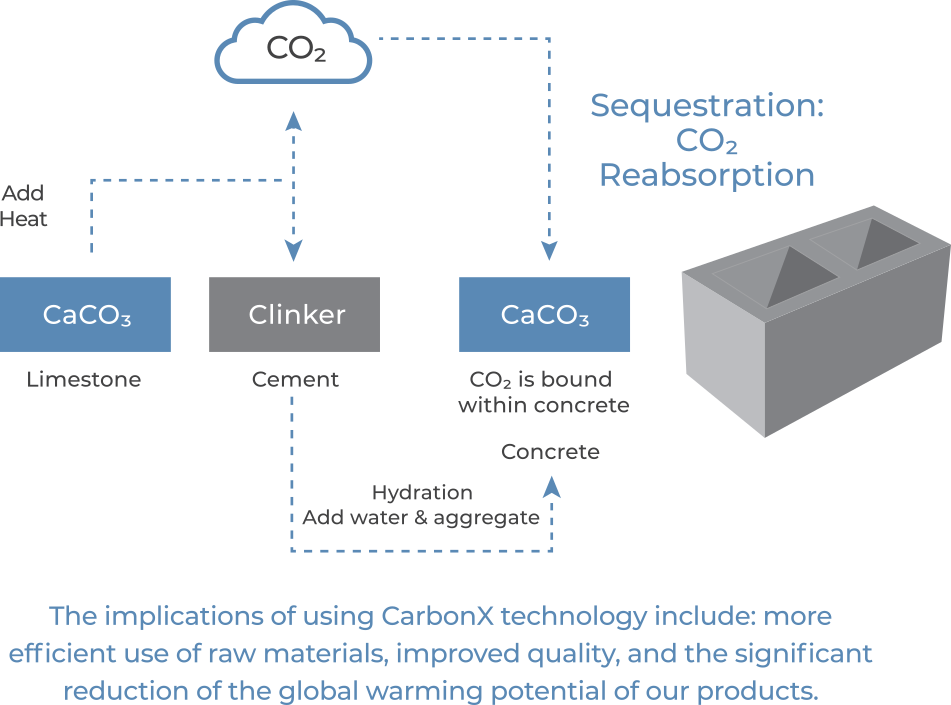
This increased reactivity not only reduces the consumption of cement, but also increases the amount of CO₂ sequestration that occurs during and following production. Carbon dioxide from ambient air reacts with the constituents of the CMU and is permanently sequestered as calcium carbonate within the block, creating a carbon sink. This reaction does not affect the performance or strength of the block, and in some cases increases it.
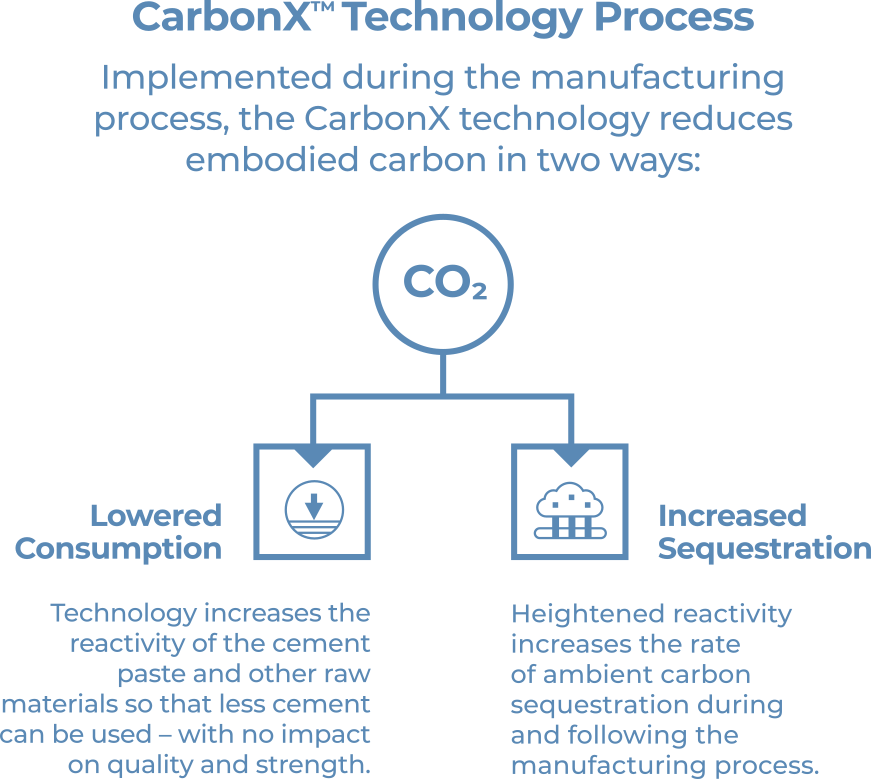
Breakthrough technology reduces embodied carbon by reducing cement content — without diluting with cement substitutes (which tend to reduce CMU strength, slow curing, and therefore slow construction time).
Breakthrough technology reduces embodied carbon by reducing cement content — without diluting with cement substitutes (which tend to reduce CMU strength, slow curing, and therefore slow construction time).
Breakthrough technology reduces embodied carbon by reducing cement content — without diluting with cement substitutes (which tend to reduce CMU strength, slow curing, and therefore slow construction time).
Breakthrough technology reduces embodied carbon by reducing cement content — without diluting with cement substitutes (which tend to reduce CMU strength, slow curing, and therefore slow construction time).
The technology re-engineers the generally accepted mixing, batching and curing methods used in the industry. This allows the production of concrete products that meet accepted strength and performance standards while using significantly less cement. The reduction is made without relying on cement substitutes — a significant departure from prior industry attempts at cement reduction.
The CarbonX technology enhances the amount of carbon dioxide the concrete product can sequester during the curing and storage phases. As a result, the product can demonstrate significant amounts of sequestration from “cradle to gate” even before it is delivered to the customer.
The manufacturing process is very cost-effective and yields other product quality enhancements. The technology allows manufacturers to avoid leaving excess unhydrated cement in the finished concrete product — unhydrated cement can cause problems such as efflorescence.
For the first time, a masonry industry-vetted protocol now exists for easy measurement of carbon sequestration. All CarbonX-based products have documented performance characteristics regarding cement content and carbon sequestration rate, along with standard test results for strength.
Lower Embodied Carbon
Permanent Carbon Sink
Journal Published Protocol
Product Lines Available
Whether you need product specs, samples, or help choosing the right block — we’re here.